
Keith Haring is one of the most recognisable and influential artists in the history of street art. His dancing figures, bold black lines, vibrant colours and iconic “Radiant Babies” became a universal visual language that is still part of popular culture today. But behind his seemingly simple drawings was much more: a desire to make art accessible to everyone, to occupy public spaces and to address social and political issues.
Although his career was relatively short, Haring transformed the relationship between art, the city and the public. His influence can still be seen in contemporary street art, including in cities such as Barcelona.

(Image credit: Fred Romero)
Who was Keith Haring?
Keith Haring was born in 1958 in Reading, Pennsylvania, and showed an interest in drawing and visual culture from a young age. In the late 1970s, he moved to New York, where he became part of an artistic scene undergoing enormous transformation.
New York became the perfect setting for Haring to develop his visual language. He began drawing in public spaces, particularly on the black advertising panels covering empty spaces in the city's subway stations. Using white chalk, he created quick, spontaneous drawings that could be seen by thousands of people.
This aspect is fundamental to understanding his importance. For Haring, art did not have to be locked inside a gallery or reserved for a select few. Public space could become a place for creation and communication.
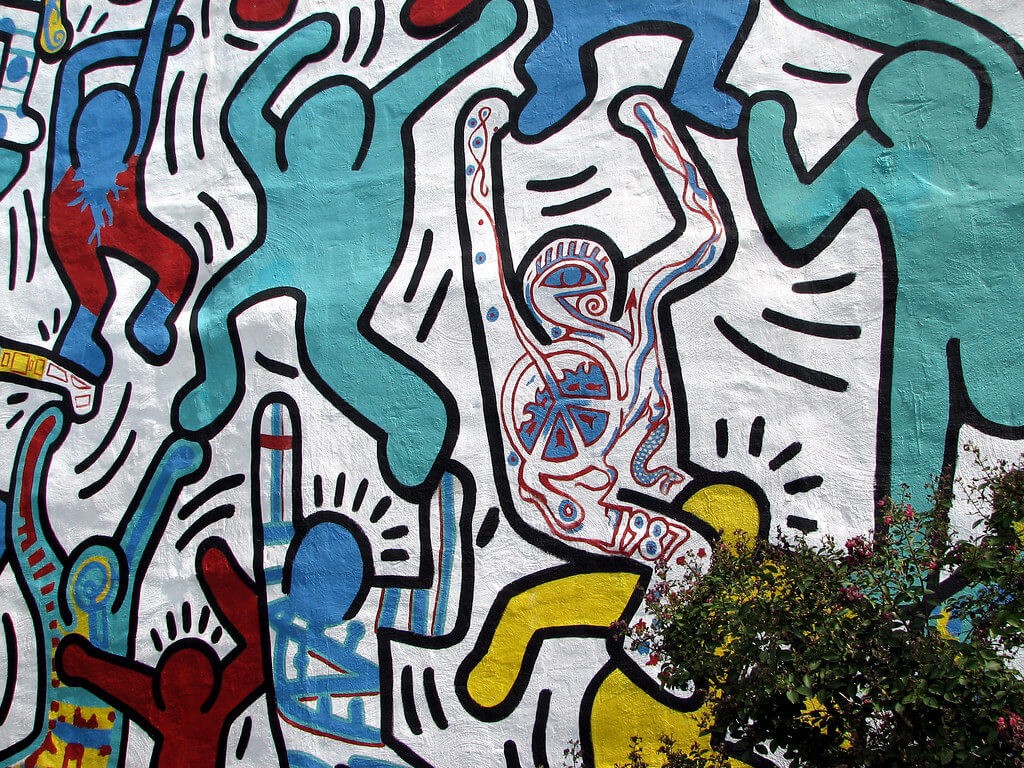
His style was direct, recognisable and apparently simple. However, his images were full of meaning. Dogs, babies, human figures, angels, hearts and dancing characters appeared repeatedly throughout his work, creating a visual vocabulary that could be understood almost without words.
(Image credit: chrisinphilly5448)
Keith Haring art and the birth of a new visual language
One of the most interesting characteristics of Keith Haring’s art is precisely its ability to communicate complex ideas through very simple forms.
His characters are usually represented with thick black lines and surrounded by elements that convey movement and energy. The radiant lines around a figure, for example, could represent life, energy or movement.
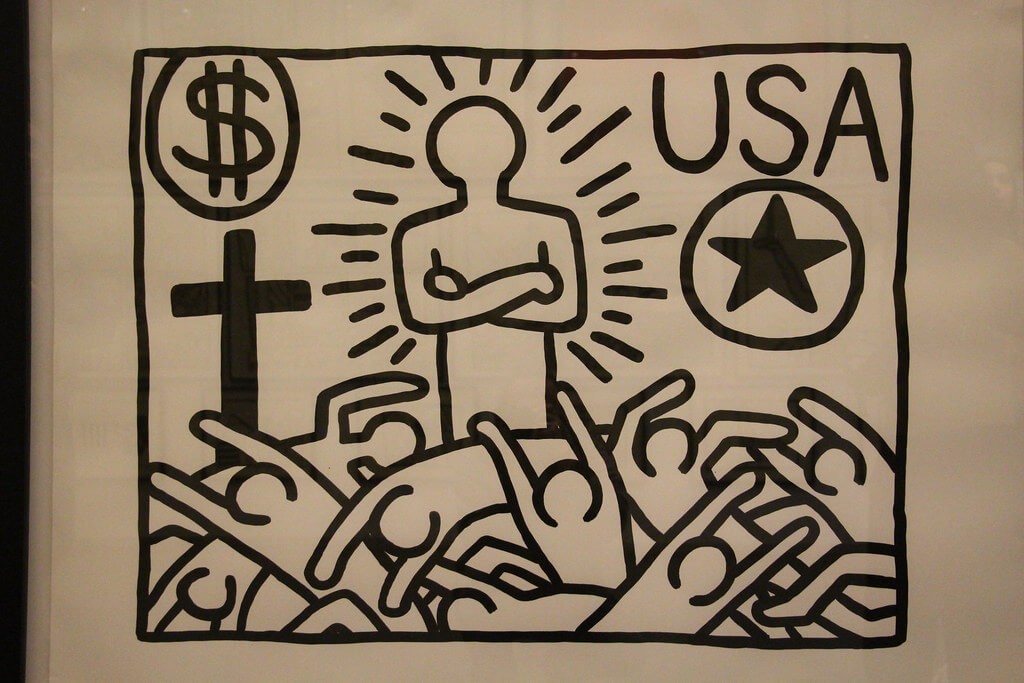
The famous Radiant Baby, one of his best-known symbols, became a representation of hope, innocence and life. At the same time, Haring used his imagery to address issues such as AIDS, homophobia, racism, social inequality, war and political power.
This is why reducing his work to a fun or colourful aesthetic would only scratch the surface. His visual language was accessible, but his messages could be deeply critical.
Haring understood that an image could communicate across cultural and linguistic barriers. His symbols were easy to recognise, but they could carry very different meanings depending on the context in which they appeared. This combination of simplicity and social commentary became one of the defining characteristics of his career.
(Image credit: Fred Romero)
Keith Haring and street art
The relationship between Keith Haring and street art is particularly important because he helped demonstrate that art created in the street could have the same cultural impact as art produced within traditional institutions.
Haring belonged to the same generation and artistic scene as other fundamental New York artists, such as Jean-Michel Basquiat. Graffiti, hip hop, music and underground culture were all part of the environment in which he developed his work.
However, Haring created a style of his own. While graffiti was strongly connected to lettering, tags and the identity of individual writers, Haring developed a system of symbols and characters that could be understood by almost anyone.
The connection between Keith Haring graffiti and traditional graffiti culture is therefore an interesting one. Although Haring's work is often associated with graffiti and street art, his approach was different from that of traditional graffiti writers. Rather than focusing primarily on names and lettering, he created an instantly recognisable visual language based on figures, symbols and movement.
His work demonstrates that urban art does not have to be exclusively decorative. It can be immediate, democratic and, at the same time, deeply political.
This idea was central to Haring's practice. By creating work in public spaces, he could reach people who might never visit a museum or contemporary art gallery. The street became both his canvas and his audience.
(Image credit: Guglielmo Giambartolomei, via Wikimedia Commons)
Keith Haring mural: when art takes over the city
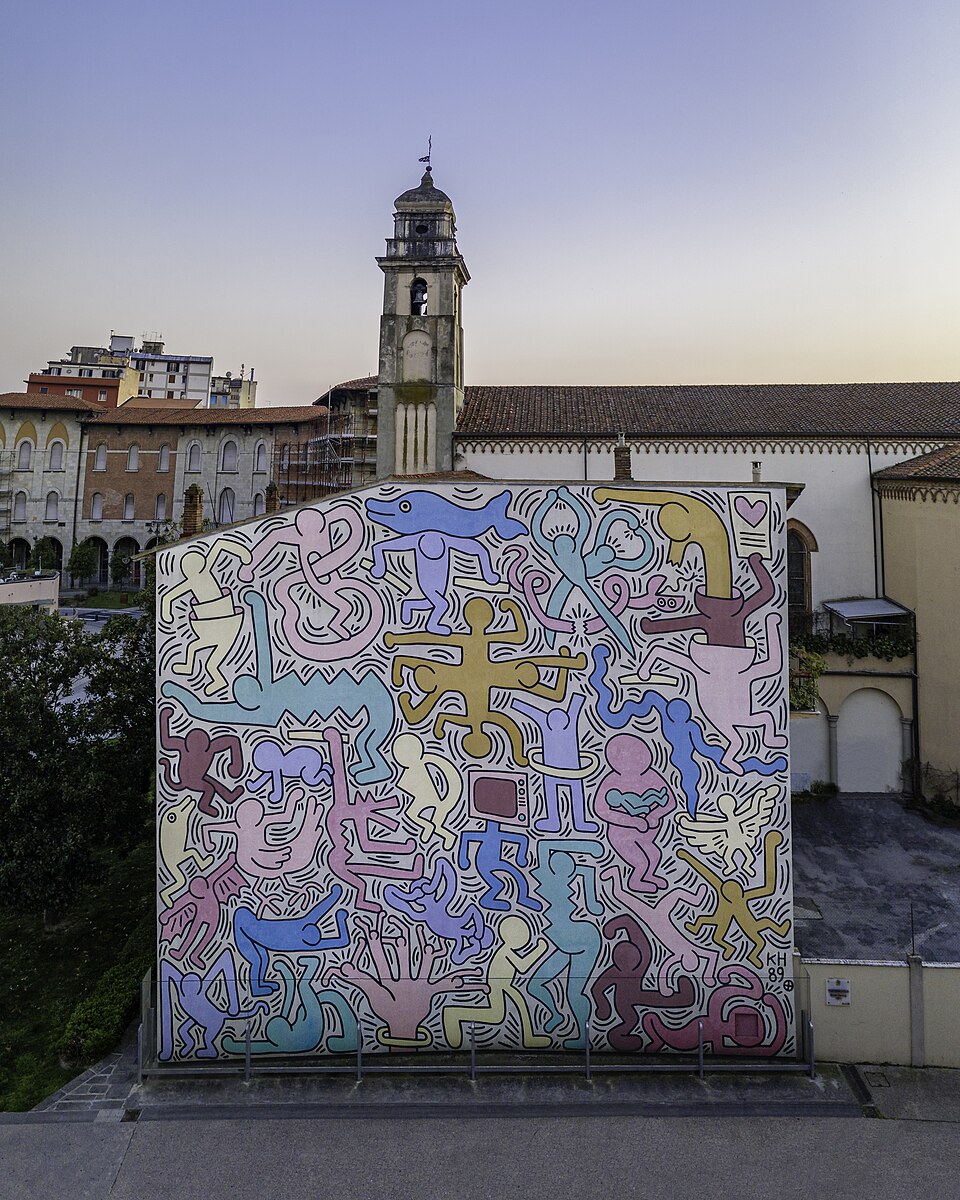
The Keith Haring mural is another important expression of his career. Haring brought his visual language to large surfaces, transforming walls and buildings into enormous compositions filled with movement.
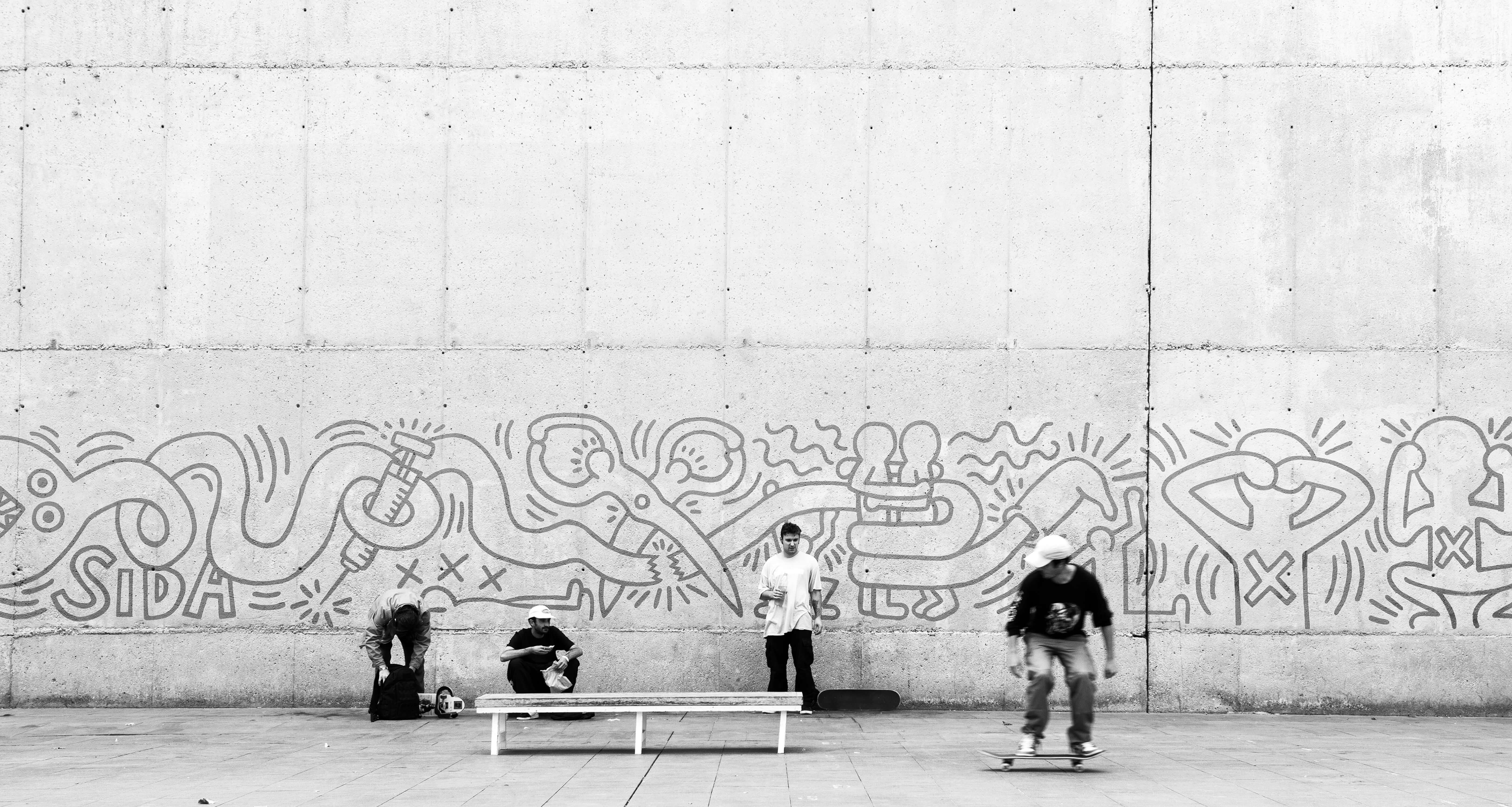
One of the best-known examples is Crack Down, created in Barcelona in 1986. The mural was produced as a protest against drugs and was later restored and relocated to a public space in the city. Its presence demonstrates just how closely Barcelona was connected to the artist's international career.
Haring's murals are particularly relevant because they maintain one of the essential characteristics of his work: a direct connection with people. A large wall can become a collective message, visible to everyone and capable of transforming an urban space.
His murals also show how effectively his visual language could adapt to a larger scale. The bold lines, repeated figures and dynamic compositions become even more powerful when they occupy an entire wall.
For Haring, these large-scale works were not simply decorative additions to a city. They could communicate a message, draw attention to social issues and make art part of everyday life.
Keith Haring in Barcelona: his connection with the city
Talking about Keith Haring in Barcelona means talking about a particularly interesting relationship. The artist visited the city in the 1980s and left a mark that remains part of its artistic memory.
During his time in Barcelona, he created different drawings and works, but the best-known example is the mural connected to the fight against AIDS and drugs. His work in the city belongs to a period when Barcelona was establishing itself as one of Europe's major cultural and creative centres.
The connection between Haring and Barcelona is particularly significant because of the city's longstanding relationship with public art. Barcelona has a strong tradition of murals, graffiti, illustration and other forms of urban expression, making it a natural environment for an artist who believed so strongly in bringing art into the streets.
Haring's influence can also be understood within the urban art tradition that characterises Barcelona. From large-scale mural interventions to smaller independent projects, the city continues to be a place where artists use the streets as a canvas to experiment, communicate and connect with the public.
Where can you find art similar to Keith Haring?
Although BAS does not have original works by Keith Haring, our selection does include contemporary artists whose work shares some of the elements that made his visual language so distinctive: intense colours, recognisable figures, expressive lines, references to urban culture and a direct connection with public space.
This offers an opportunity to explore some of the ideas that Haring helped popularise from a contemporary perspective. Street art has evolved enormously since the 1980s, but many artists today continue to use art to break down the boundaries between the street and the gallery.
At BAS, we believe in precisely this connection. Our selection brings together different artists, including Felipe Pantone and Okuda San Miguel, and a variety of styles connected to urban art, from graffiti to muralism and other contemporary forms of expression.
While these artists have their own distinctive identities and visual languages, exploring their work can be an interesting way to understand how the ideas associated with artists such as Haring continue to evolve today.
So, if you are interested in Keith Haring’s art, discovering artists with a similarly energetic visual approach can be an interesting way to continue exploring the movement and see how contemporary artists are reinterpreting the relationship between art, colour, the city and popular culture.